
New economic research finds that unrestricted ticket resale delivers greater consumer benefits than seller-controlled exchanges.
What happens when fans have fewer places to buy tickets? Less competition means fewer choices, less pressure to keep prices down and more control in the hands of whoever sells the tickets.
At NATP, we believe professional ticket sellers provide real value to fans through competition, access and service.
Now, new economic research from the University of Virginia and University of Pennsylvania provides independent support for that important principle: consumers benefit when ticket resale remains competitive.
Their research finds that unrestricted resale produces greater economic benefits for consumers than resale exchanges controlled by the original, primary ticket seller. It also helps explain why controlling ticket resale can be financially attractive to primary ticket sellers, even when consumers would benefit more from an open, competitive market.
The Research: More Revenue for Sellers, Less Benefit for Fans
In their 2026 working paper, The Enigma of Ticket Exchanges (and Other Reselling Markets) and the Design of Commission Fees, professors Gérard Cachon and Pnina Feldman examined the economics of ticket resale.
The researchers compared several approaches, including unrestricted resale and resale exchanges controlled by the original ticket seller. Their findings are particularly relevant to the ongoing debate over ticket transfer restrictions, exclusive resale platforms and consumer choice.
Under the researchers’ economic model, primary ticket sellers can make more money by controlling resale transactions than by allowing tickets to be bought and sold in an open, competitive market.
But here’s the important finding for fans: the researchers found that consumers received greater economic benefits when resale was unrestricted than when it was controlled by the original seller. Economists call this consumer surplus, but the takeaway is simple. Competition can deliver better value for ticket buyers.
Think about that. What makes the most money for the original ticket seller isn’t necessarily what’s best for fans.
That helps explain the financial incentives behind efforts to restrict independent ticket resale. When a primary seller controls both the original ticket sale and the resale transaction, it has more opportunities to collect fees and capture revenue that might otherwise flow through competing providers.
That’s why maintaining an open secondary ticket market matters. Independent ticket sellers, like those in the NATP, and marketplaces give fans competing options for pricing, access and service. Those options provide real economic value, and this university research helps explain why preserving them benefits consumers.
A Real-World Example: The 2026 FIFA World Cup
The economics of controlled resale are particularly relevant when considering the 2026 FIFA World Cup. FIFA operates an official resale exchange that charges a 15% fee to buyers and another 15% fee to sellers. Consider a ticket resold for $1,000.
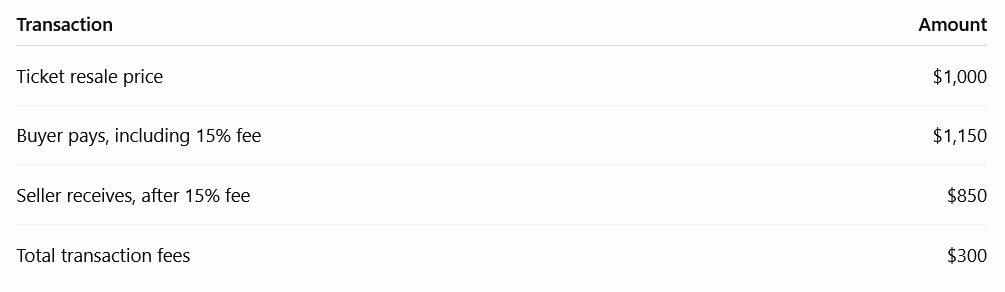
That is $300 in combined fees generated from a ticket that was already purchased in the primary market. The example does not establish how much of those fees FIFA ultimately retains, but it does illustrate why controlling resale transactions can be financially attractive.
For consumers, the question is straightforward: Would you rather have one place to buy and sell tickets, or multiple providers competing for your business on price, fees and service?
Why an Open Resale Market Matters
Ticket resale serves many practical purposes. It gives fans access to events and tickets they might not otherwise be able to purchase. It also provides an option for fans who buy tickets months in advance but later cannot attend. Resale allows tickets to move between willing buyers and sellers. Millions of fans voluntarily buy tickets through the secondary market each year because they find the tickets, prices or service they’re looking for. That’s consumer choice in action.
In an open market, independent ticket sellers and marketplaces compete for those transactions. Consumers can compare different available tickets and prices and competing platforms have incentives to provide better pricing, service and consumer protections.
NATP members are a big part of that competition. They help fans find competitive prices, access a wider selection of tickets and secure seats for events in their hometowns, across the country and around the world. They offer a wide selection of tickets, personalized service and expertise built over decades in the ticket industry. That can be particularly valuable for high-demand events, or when a fan needs a premium seat location. Every member of the NATP members also stand behind their transactions with consumer guarantees and a commitment to reliable ticket delivery. These services are part of the value our NATP members bring to the live-event economy. Eliminating legitimate resale competition would remove those options and reduce the competitive pressure that helps keep ticket prices in check and service levels up.
The Darden and Wharton research helps explain what can happen when the original seller also controls the secondary transaction. Resale commissions can discourage competing resellers from lowering prices, allowing the original ticket seller to generate more revenue while consumers receive less economic benefit.
Primary ticket sellers have every right to participate in the resale market. The concern arises when those same companies use their control over ticket distribution and transfer technology to prevent fans from choosing competing providers. Competition should be determined by price, service and trust, not by one company deciding where fans are allowed to shop.
Every ticket company should have to earn a customer’s business, not receive it because the customer has nowhere else to go to buy tickets.
Protecting Fans Shouldn’t Require Restricting Competition
The NATP supports strong consumer protections, including reliable ticket authentication, transparent pricing, and guaranteed delivery. Those protections are essential to a healthy ticket industry. But they should not require consumers to buy or sell tickets exclusively through a primary ticketing company’s approved exchange.
Technology exists to support ticket verification, secure transfers and legitimate transactions across multiple marketplaces. Open transferability and open authentication would allow consumers to benefit from competition without sacrificing security. NATP has previously outlined how these two ideas could improve the ticket-buying experience in A Better Ticket Industry Starts With Two Simple Ideas: Open Transfer and Open Authentication
Primary ticketing companies should be free to compete for resale transactions. But so should non-affiliated ticket marketplaces and professional ticket resellers. And most importantly, fans should be free to choose among those options and decide for themselves where they want to purchase tickets.
Policymakers Should Follow the Economics
As legislators consider ways to improve the ticket industry, they should pay close attention to the financial incentives behind proposals to restrict resale. Those restrictions are often promoted as consumer protections, but in many cases they may financially benefit the companies that control the original ticket sale more than the fans buying tickets.
The research from Cachon and Feldman provides an important perspective to support that statement. Their economic model finds that seller-controlled exchanges can increase original-seller revenue while reducing consumer surplus relative to unrestricted resale. Although the study is based on an economic model rather than an analysis of actual ticket transactions, its findings provide a useful framework for evaluating the potential consequences of resale restrictions.
Lawmakers should ask whether a proposed primary ticket seller restriction will make tickets cheaper, safer and transactions more transparent, or whether it will simply reduce consumers’ ability to shop in a competitive ticket market. Those are very different outcomes.
NATP believes independent ticket sellers provide real value to consumers through competitive pricing, access to a wider selection of seats, expertise and a higher-level of service. Research like this helps explain why those benefits matter and why preserving competition should be a priority for policymakers.
The ticket industry needs more transparency, better authentication, effective fraud prevention and meaningful competition, not fewer legitimate places for fans to buy and sell tickets.
Fans benefit from having choices. And this independent university research provides another compelling reason to protect competition and the valuable services that professional ticket sellers provide.
Sources
- Gérard P. Cachon and Pnina Feldman, The Enigma of Ticket Exchanges (and Other Reselling Markets) and the Design of Commission Fees, 2026. https://papers.ssrn.com/sol3/papers.cfm?abstract_id=6899618
- University of Virginia Darden School of Business, Why Ticket Sellers Learned to Love the Resale Market. https://news.darden.virginia.edu/articles/why-ticket-sellers-learned-to-love-the-resale-market
- FIFA, Official FIFA World Cup 2026 Ticket Resale/Exchange Platform terms and fee information. https://www.fifa.com/tickets